
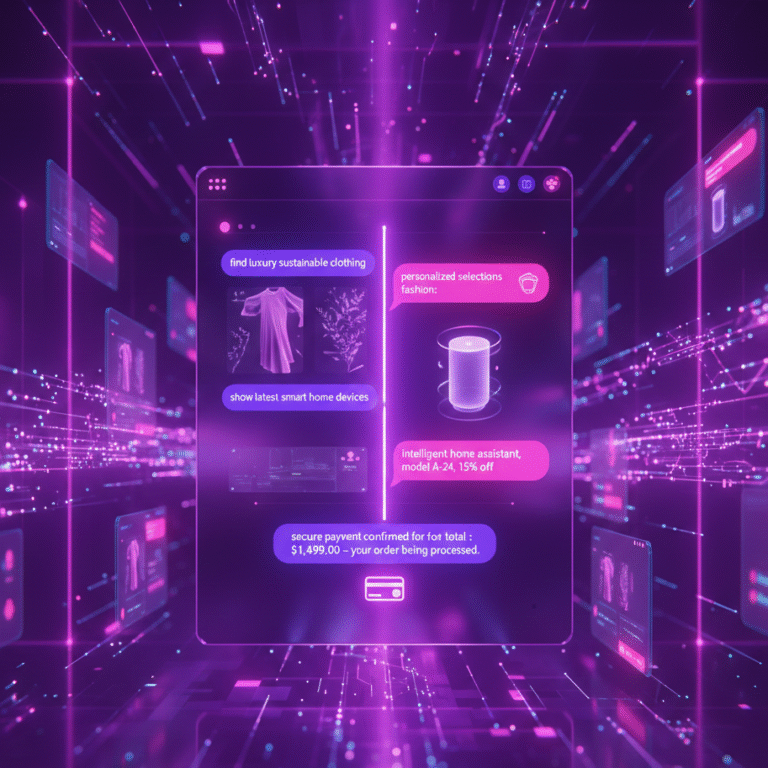
The world of digital commerce has undergone a radical transformation in recent years, as artificial intelligence has become a core component of the user experience. Recently, Google launched the UCP (Universal Commerce Protocol), which turns artificial intelligence into a full purchasing agent capable of managing the entire shopping process, from search to payment, within a single conversation, with minimal user intervention, in what is expected to be a unique and distinctly different experience.
At the same time, optimizing digital content specifically for artificial intelligence agents has become an essential requirement to ensure that these agents can process information accurately and make reliable purchasing decisions, ultimately enabling users to gain the maximum possible benefit from this technology.
In this article, we will explore each concept individually, then explain the connection between them and how businesses can leverage this integration to deliver a smart, seamless, and fully integrated shopping experience.
UCP Protocol for AI-Powered Purchasing
What Is the UCP Protocol?
UCP is a protocol developed by Google to redefine digital commerce through artificial intelligence. Experts state that its primary goal is to transform artificial intelligence from a simple virtual assistant into a full purchasing agent, capable of executing the entire buying process within a single conversation.
How Does UCP Work?
- Smart Search:
When using UCP, artificial intelligence begins by analyzing the user’s needs and searching for the most suitable products or services. In doing so, it relies on several key factors, including:- Price.
- Customer ratings and reviews.
- Offers and discounts.
- Product availability and delivery speed.
- Comparison and Decision-Making:
After collecting the relevant data, the second step of the process begins, where artificial intelligence compares different products and selects the optimal option based on predefined criteria. The main advantage of this step is that it reduces human error and significantly speeds up decision-making. - Payment Completion:
Artificial intelligence can complete the payment process directly by using previously stored payment methods, without requiring user intervention at every step. This makes the experience faster and easier, saving a significant amount of time and effort. - Single-Conversation Experience:
What makes this approach different is that all the previous steps take place within a single conversation window, whether on Google Assistant, Google Chat, or integrated e-commerce platforms. This creates a smooth, unified, and seamless shopping experience.
Benefits of UCP for Users and Businesses
- For users: Ensuring a faster and smarter shopping experience, while reducing the effort required for searching, comparing, and completing payments.
- For businesses and retailers: Increasing conversion rates through a seamless purchasing experience, and improving customer targeting by leveraging accurate data about user needs and behavior.
Optimizing Personalized Content for Artificial Intelligence Agents
For UCP, or any artificial intelligence agent, to perform its role efficiently, it requires well-structured and clearly organized digital content. Without high-quality content, artificial intelligence cannot deliver accurate recommendations or make reliable purchasing decisions. This highlights the long-term importance of content in enabling AI agents to function effectively and in creating a clear, noticeable difference in the user experience.
What Is AI-Optimized Content?
AI-optimized content is content that is designed in a way that allows artificial intelligence to easily understand, process, and interpret it. This includes:
- Providing accurate and detailed product descriptions.
- Clearly defining features and specifications.
- Explaining prices and discounts in a transparent manner.
- Using structured data that artificial intelligence agents can read and interpret directly.
How to Optimize Content for Artificial Intelligence
Clear and readable structure:
This includes using H2 and H3 subheadings, and organizing information into bullet points or tables to improve clarity and readability.
Direct and precise language:
Avoiding ambiguity and figurative language, and instead using clear, straightforward wording that accurately describes the product or service.
Structured data implementation:
Using Schema Markup or JSON-LD to describe products, specifications, prices, and availability. This allows artificial intelligence to quickly understand the information and use it for comparisons or recommendations.
Regular content updates:
Continuously updating prices, promotions, and reviews to ensure that all recommendations remain accurate and up to date.
Why Content Optimization Matters
- It enhances the ability of artificial intelligence to deliver precise and relevant recommendations.
- It ensures a smooth, trustworthy, and consistent user experience.
- It increases the likelihood of completing purchases and achieving higher customer satisfaction.
The Relationship Between UCP and Optimized Personalized Content
When UCP is integrated with content optimized for artificial intelligence, a highly effective synergy emerges between technology and digital content, as outlined below:
High-quality content enables AI agents to understand options quickly:
For example, when product descriptions are detailed and well-structured, artificial intelligence can compare multiple products with greater accuracy and efficiency.
UCP relies on content to make intelligent purchasing decisions:
If the content it draws from is poorly organized or inaccurate, artificial intelligence may select suboptimal options or provide unreliable recommendations. This reality is driving businesses to invest in content optimization in the near term to ensure continuity, accuracy, and long-term effectiveness.
An ideal user experience:
When optimized content is combined with UCP, it delivers a smooth, precise, and fast purchasing experience, where search, comparison, recommendation, and payment are all completed within a single, seamless step.
In summary, high-quality content serves as the fuel for artificial intelligence, while UCP acts as the engine that converts this fuel into a fully integrated digital shopping experience.
Tips for Businesses to Enhance the AI-Driven Shopping Experience
- Improving product descriptions to make them more detailed and accurate.
- Paying close attention to regularly updating prices and promotional offers.
- Using Schema Markup to enhance product visibility in search engines and enable artificial intelligence agents to easily understand and process data.
- Simplifying the payment process and integrating it with artificial intelligence to deliver a smooth and frictionless experience.
- Continuously analyzing customer behavior to refine recommendations and create a smarter, more personalized shopping experience.
With the launch of the UCP protocol and the optimization of content tailored for artificial intelligence agents, digital commerce is expected to witness a significant qualitative shift. This transformation is driven by the evolution of artificial intelligence from a simple assistant into a fully integrated and efficient purchasing agent, capable of making fast and accurate decisions that truly support users.
The greatest beneficiaries of this shift are companies that invest in optimizing their digital content, such as we do at Lhamim Creative Communications, as these businesses will be the ones able to deliver smarter experiences to their users. Customers will be able to complete purchases with unprecedented ease and speed, from search to payment, all within a single conversation.
This represents the new future of digital commerce: the integration of artificial intelligence with well-structured digital content to create a seamless, intelligent, and fully integrated shopping experience.