
The Saudi nuclear age: how the 123 Agreement opens the way to the future of energy
More than eight decades after reshaping the global economy through oil, the Kingdom is opening a new chapter in energy with a civil nuclear programme that supports Vision 2030. This report explains the agreement, the pillars and the impact.
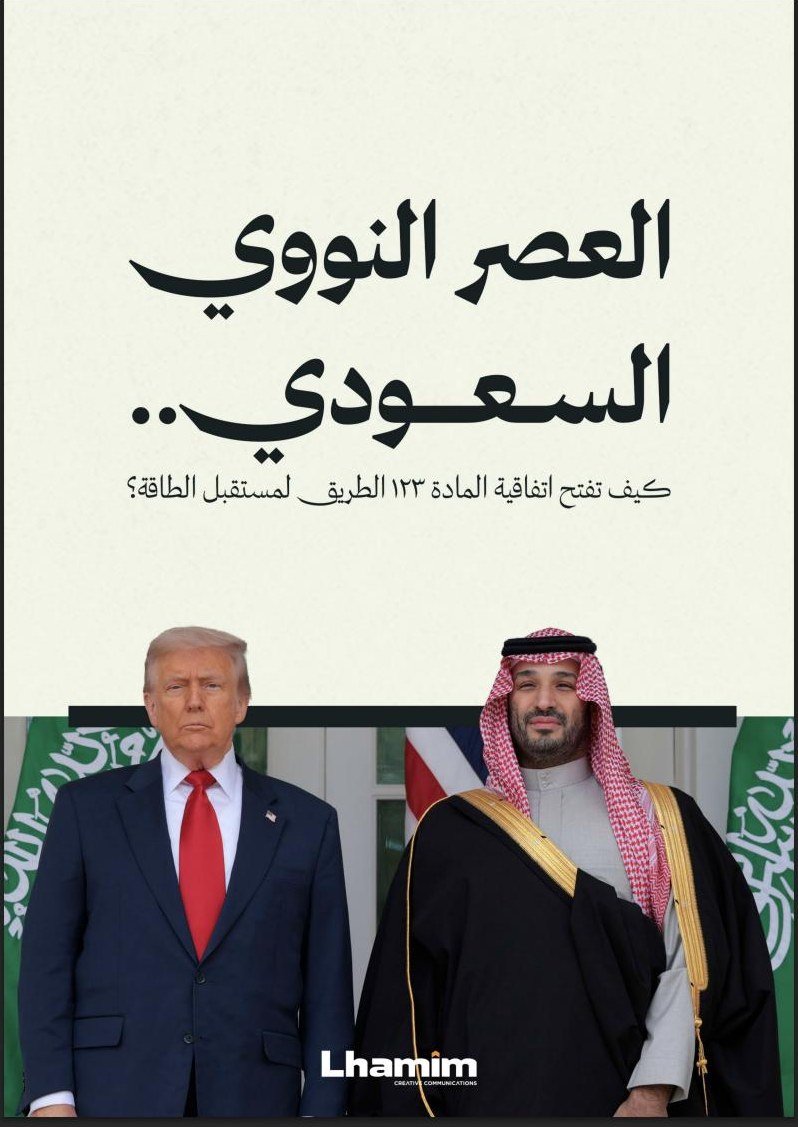
- 123the section of the US Atomic Energy Act behind the agreement
- 30years of partnership, according to US media
- 5pillars of the civil nuclear programme
- 1954the year the US Atomic Energy Act was passed
Sources as cited in the report: the agreement document signed by the two countries' energy ministers, and US media reports.
What is the 123 Agreement?
It is a document signed by the US Secretary of Energy and the Saudi Minister of Energy, which the US administration submits to Congress to begin the legislative steps for approval. It rests on a section of the US Atomic Energy Act of 1954 and allows a civil nuclear partnership between the two countries.
According to US media reports, the partnership runs for 30 years. It covers the participation of American companies in developing the programme and its infrastructure, the transfer of technology and expertise, and a study of a uranium enrichment facility inside the Kingdom.
The programme's five pillars
An integrated industry
A civil nuclear industry covering supply chains, engineering, technical services and supporting industries, to raise local content.
The fuel cycle
Developing the nuclear fuel cycle inside the Kingdom and using national uranium resources, within regulatory frameworks and international commitments.
Energy security
Raising the competitiveness of energy-intensive industries such as data centres, artificial intelligence and hydrogen production.
A new sector
An economic and technical sector that transfers knowledge, develops national talent and attracts quality investment.
Sustainability
Cutting carbon emissions by relying on a low-emission source of electricity.
Why now?
The world has been through two major stages in the history of energy: coal, which drove the industrial revolution, then oil, which changed the global economy. Nuclear energy is now entering a new stage as a low-emission source of stable electricity around the clock.
Every megawatt produced by reactors reduces the fuel used to generate electricity, and every barrel saved at home can go to export or to higher-value industries, within a balanced mix of oil, gas, solar, wind and nuclear.
Beyond electricity
Desalination
Reactors can desalinate seawater with high efficiency.
Nuclear medicine
Producing the isotopes used in diagnosis and in treating tumours.
Heavy industry
Energy for mining, metals, petrochemicals and low-emission hydrogen.
Research and innovation
Support for research in engineering, advanced materials and artificial intelligence.
What this means for your organisation
A subject that needs explaining
Nuclear energy is technical and sensitive. Organisations connected to it need clear messages that explain the benefit before other narratives fill the gap.
Opportunities across sectors
Supply chains, engineering, training, medicine and water are all part of the picture, and each sector has its own story.
The narrative is part of the project
Moving from who owns the oil to who can produce stable electricity is a change of image, and that is communications work.
Browse the report (Arabic)
Questions and answers
What is a 123 Agreement?
An agreement under Section 123 of the US Atomic Energy Act of 1954 that sets the framework for civil nuclear cooperation between the United States and another country. The Saudi-US document was signed by the two countries' energy ministers.
How long is the Saudi-US civil nuclear partnership?
30 years according to US media reports, as cited in the report.
What are the goals of Saudi Arabia's civil nuclear programme?
Five pillars: an integrated civil nuclear industry, development of the fuel cycle, energy security, a new economic and technical sector, and lower carbon emissions.
Who wrote this report?
Lhamim, as part of Lhamim Insight, a series of reports that read major campaigns and events from a communications and marketing angle. Lhamim is a Saudi communications and media agency based in Riyadh.
Is the full report available in English?
The full PDF is in Arabic. This page covers its main findings in English, and our team can walk you through it.